Tuesday, 3 February 2009
Coercion v context and commonsense
Depressing announcement from the Association of Chief Police Officers. They propose average speed cameras instead of traffic calming measures in built-up areas to deter "speeding". You can understand the rationale, but isn't it misguided to extend state control at the expense of personal responsibility? Speeding is a fabricated crime, like jaywalking. It's not speed that kills, but inappropriate speed, or speed in the wrong hands. Don't policymakers realise that people behave worse when herded and hounded, and better when free to act on commonsense and context? Is it time to start installing traffic lights at cashpoints, and speed cameras on pavements, or time to start treating road-users as grown-ups?


Tuesday, 9 December 2008
Organic v processed traffic
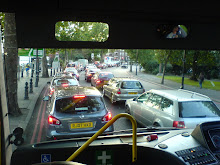
Consider the phrase "organic traffic". It suggests a living entity, capable of intelligent self-organisation. Like organic food, organic traffic is natural, sustainable. Traffic processed through a system of control is a less benign beast. Through an increasingly complex web of enforcement, traffic management seeks to control our thoughts and movements. It blocks our impulse to co-operate and go with the flow. Like commercial food production and control, processed traffic has untold dire consequences.
Saturday, 18 October 2008
Cameras can lie
A red light camera story with a happy ending. http://www.theprogressnews.com/default.asp?read=14735
Thursday, 16 October 2008
Robot drivers
http://www.northamptonchron.co.uk/news/Baths-closed-and-traffic-lights.4555083.jp When the lights were out of action, says the report, "Motorists had to be careful", implying that when lights are "working", they don't have to be (as) careful. Paradoxical but true. Lights remove responsibility for decision-making. They turn us into robots, programmed to act according to switchgear, not innate intelligence or the needs of the moment. But when we have to keep our wits about us, we are more likely to do the right thing.
Sunday, 12 October 2008
Secret intelligence
If I’m guilty of seeing ubiquitous analogies to coercive, counterproductive traffic controls, so be it. In today’s Observer, New York Times section, John le Carré says: "By extracting information under torture ... you obtain information that isn't true. You receive names of people who are supposedly guilty and aren't ... You miss what is being handed to you on a plate, and that is the possibility of bonding with someone and engaging with them and talking to them reasonably." OK, traffic controls are not exactly torture, but arguably they do contribute to untold death and injury. They do impose behaviour patterns and extract obedience. And conflict on the road is amenable to a simple solution which is staring us in the face, namely a live-and-let-live approach that enables all road-users to interact positively.
Thursday, 9 October 2008
A sign to get your goat(ie)
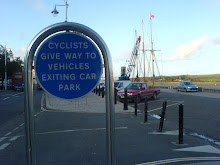
Bideford, Devon. Apart from the mean spirit the Cyclists Give Way sign reveals, you can imagine the decision-making and manufacturing processes it went through - in true local authority carbon-footprint expansionist tradition!
Subscribe to:
Posts (Atom)


 Posts
Posts