Friday, 25 June 2010
Current videos
Roads unfit for People (7.33) and Roads FiT for People (5.07). Thinking of changing campaign name to Equality Streets.


Friday, 26 June 2009
Note
Links to my stuff elsewhere: FiT Roads with a blog at Free to Choose. I proposed a lights v no-lights trial to Ealing a year ago. Currently trying to get other councils to run with the idea. It's a long haul.
Monday, 23 February 2009
Note to readers
I'm spending more time at a rather more versatile site - http://amberlight.ning.com - so see you there perhaps. This was todays' post: With all due disrespect for one-dimensional regulation, and for “campaigns” such as 'Driving for Better Business', which fail in their duty to question authority and pursue liberating change - if the ban on in-car phone use is justified because it distracts us from concentrating on the road, should traffic lights, speed cameras and speed limits be banned for the same reason?
Tuesday, 3 February 2009
Coercion v context and commonsense
Depressing announcement from the Association of Chief Police Officers. They propose average speed cameras instead of traffic calming measures in built-up areas to deter "speeding". You can understand the rationale, but isn't it misguided to extend state control at the expense of personal responsibility? Speeding is a fabricated crime, like jaywalking. It's not speed that kills, but inappropriate speed, or speed in the wrong hands. Don't policymakers realise that people behave worse when herded and hounded, and better when free to act on commonsense and context? Is it time to start installing traffic lights at cashpoints, and speed cameras on pavements, or time to start treating road-users as grown-ups?
Tuesday, 9 December 2008
Organic v processed traffic
Consider the phrase "organic traffic". It suggests a living entity, capable of intelligent self-organisation. Like organic food, organic traffic is natural, sustainable. Traffic processed through a system of control is a less benign beast. Through an increasingly complex web of enforcement, traffic management seeks to control our thoughts and movements. It blocks our impulse to co-operate and go with the flow. Like commercial food production and control, processed traffic has untold dire consequences.
Saturday, 18 October 2008
Cameras can lie
A red light camera story with a happy ending. http://www.theprogressnews.com/default.asp?read=14735
Thursday, 16 October 2008
Robot drivers
http://www.northamptonchron.co.uk/news/Baths-closed-and-traffic-lights.4555083.jp When the lights were out of action, says the report, "Motorists had to be careful", implying that when lights are "working", they don't have to be (as) careful. Paradoxical but true. Lights remove responsibility for decision-making. They turn us into robots, programmed to act according to switchgear, not innate intelligence or the needs of the moment. But when we have to keep our wits about us, we are more likely to do the right thing.
Sunday, 12 October 2008
Secret intelligence
If I’m guilty of seeing ubiquitous analogies to coercive, counterproductive traffic controls, so be it. In today’s Observer, New York Times section, John le Carré says: "By extracting information under torture ... you obtain information that isn't true. You receive names of people who are supposedly guilty and aren't ... You miss what is being handed to you on a plate, and that is the possibility of bonding with someone and engaging with them and talking to them reasonably." OK, traffic controls are not exactly torture, but arguably they do contribute to untold death and injury. They do impose behaviour patterns and extract obedience. And conflict on the road is amenable to a simple solution which is staring us in the face, namely a live-and-let-live approach that enables all road-users to interact positively.
Thursday, 9 October 2008
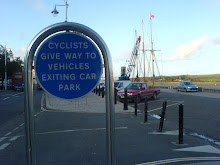
A sign to get your goat(ie)
Bideford, Devon. Apart from the mean spirit the Cyclists Give Way sign reveals, you can imagine the decision-making and manufacturing processes it went through - in true local authority carbon-footprint expansionist tradition!
Friday, 26 September 2008
Accident figures
Now the IAM (Institute of Advanced Motorists) is welcoming the 2007 accident figures. 2,946 deaths, 27,774 serious injuries, 217,060 slight injuries. As stated in various posts and articles, the unreported cause of accidents is the law of the road itself. Main road priority imposes inequality and makes roads lethal. So lethal that, as John Adams says, children aren't allowed to cross the road and old people daren't cross them. The figures are cooked. Rules should be tailored to fit human nature. The opposite is the case. When things go wrong, who gets the blame? The devisers of the system? No. They go unquestioned. We get the blame. And we have to bury our dead, tend our wounded, and face more coercive control.
Thursday, 25 September 2008
Road deaths
In its press release today, the RAC welcomes the news that 229 fewer people died on UK roads in 2007 than 06. It thinks safety campaigns have helped. 72 fewer young drivers died, but made up 42% of driver deaths. 33% of accidents were caused by inattention; 16% by drink driving. The RAC warns against (though doesn’t attribute any deaths to) mobile phone use. It says there is no room for complacency, and accident rates "can only be tackled by consistent, high-profile enforcement of the law by expert traffic police".
Not a word about rethinking the rules of the road that make roads lethal in the first place.
Not a word about rethinking the rules of the road that make roads lethal in the first place.
Wednesday, 17 September 2008
From the scandalous to the sublime
Another female cyclist, Lisa Pontecorvo, killed at traffic lights. Holloway Rd, junction Fielding Crescent. Crocodile expressions of regret from the officials who preside over our unfit roads. Sublime, but only for a while: at a major junction on Honiton Road in Exmouth, lights were out for three weeks. People wrote in saying how pleasant and uncongested it was. Now lights are back on, it's a return to familiar delay and aggravation.
Monday, 25 August 2008
Dangerous rules of the road
A classic example of the rules setting the stage for conflict. I was in Brighton (Hove) trying to turn right from a "side" road into a main road. DfT guidance says conflict points should be minimised, but if you're trying to exit from a side road, you face conflict from both sides. I began to nose out to see past the line of parked cars to my right. Nothing coming, so I look left, and someone is bang in front of me, inches away, turning right across me, gesticulating. Don't let me go first, will you, even though it’s good-mannered and much easier for you to give way to a right-turner whose view is restricted. Again I start inching out, and whoosh! another car travelling at an inappropriate but legal speed goes uncomfortably close. If roads were fit, if all road-users had equal rights, people would show consideration and take it in turns. In a sense, those aggressive drivers are not to blame. They are just following the rules of the road, which create war zones with battle lines drawn by policymakers. They f*** us up, the engineers. They may not mean to, but they do.
Injustice system
“Instant justice is creating a nation of criminals”, says a report by Professor Rod Morgan, former chief inspector of probation and ex-chair of Youth Justice Board. He warns that increasing use of fixed penalty notices is leading to criminal records for minor matters such as fare dodging, while serious violent offenders receive cautions. Analagously, the rules of the road kill and criminalise us, while the unaccountable perps in the traffic control dictatorship continue to lord it over us to our detriment.
Tragic traffic management
Tom says driving is a complex task, but seems to blame human inability to concentrate or cope. I’ve always advocated phasing in the advanced driving test, but for my money the original sin is fatuous traffic regulation bolstered by barbaric road design and a culture of coercion, blame and enforcement. Traffic "experts" manufacture an alien environment which interferes with our innate ability to negotiate safe and efficient movement - in Ken Todd's phrase, it's "an exercise in self-defeat". After they tie us in knots, we are left to carry the can. It would be a farce if it wasn't a tragedy.
Sunday, 24 August 2008
Tom Vanderbilt's Traffic
Observer review of Tom Vanderbilt’s Traffic concludes that "most of our traffic problems come down to the innate weakness of our species – inability to judge risk, thrill-seeking ... greed." The book must be more subtle, but in response I reiterate my point that if you remove the unfit priority rule, you’ll make roads fit for people and peaceful coexistence will break out.
Carping about parking
On the back of a Brighton bus was this from a 2006 RAC report: 28% of motorists drive an extra 20 minutes in search of parking. Presumably it’s intended as an argument for going by bus. Or is it a case for making parking easier? Not everyone can suddenly start going by bus. A bus can’t do door-to-door or enable multiple trips with equipment. If parking were less restricted, there would be an immediate drop in fuel use and emissions from 10m motorists x 365 days a year. Or is it better to continue punishing the people and the planet?
Friday, 22 August 2008
Lights = trouble. No lights = no trouble
Dead red time
With the unquantifiable dead red time it generates, the traffic control system is inefficient. By making us watch lights and cameras rather than the road, it's dangerous. Far from easing the task of negotiating movement safely on busy roads and streets, the system's battery of control adds to it, unnecessarily and vexatiously. After the predators catch us in one of their traps, they criminalise and penalise us. Endless instructional and warning signs distract and unsettle us – BUT WHERE ARE THE DIRECTIONAL SIGNS WHEN WE NEED THEM!?
Subscribe to:
Posts (Atom)


 Posts
Posts